






 |
 |
 |
 |
CONTACT ME
HOME
ABOUT ME
ORGANS
BYGONES



GRAMOPHONES



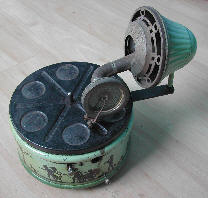
An exception to the above is the NIRONA, shown above, a quality German children’s gramophone.
It was unusual in that a standard full size motor was used. A distinctive bell shaped “horn” is used which gives a surprisingly good reproduction.
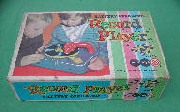
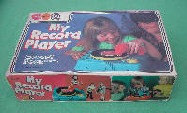
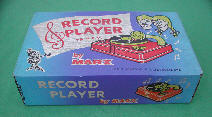
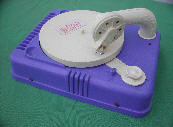
A much later gramophone was made in the 1960’s by Louis Marx & Co. of Swansea.
Although made of plastic and battery operated, it retains acoustic reproduction, uses steel needles and plays at 78 rpm. I would think that this was the last toy to retain these features. Does anyone know otherwise ? Plastic records were supplied by Marx for this gramophone under the Kidditune label.
It was unusual in that a standard full size motor was used. A distinctive bell shaped “horn” is used which gives a surprisingly good reproduction.
A much later gramophone was made in the 1960’s by Louis Marx & Co. of Swansea.
Although made of plastic and battery operated, it retains acoustic reproduction, uses steel needles and plays at 78 rpm. I would think that this was the last toy to retain these features. Does anyone know otherwise ? Plastic records were supplied by Marx for this gramophone under the Kidditune label.
CHILDREN’S GRAMOPHONES
Most of these were cheaply produced toys and were only intended to play small records. Nearly all had the most basic motors, similar to those found in toy trains. Some used a short trumpet style horn, whilst other used an internal horn. They were usually wound by a key, either through a hole in the side or an aperture in the turntable.
One lever controlled the motor and you guessed the speed.
There seem to have been two main types :-
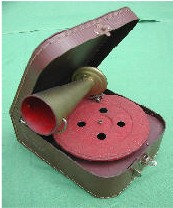
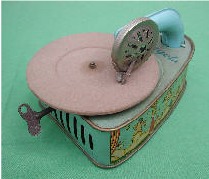
The ‘Bingola’, made in Germany
The ‘Kiddyphone’, made in Germany
Miniature gramophone, manufacturer unknown
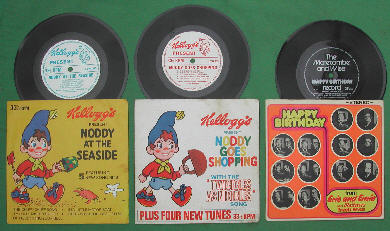
Ultra-flexible records. These were issued in vast quantities during the 1960’s & 1970’s. Most were free promotional records tempting you to buy sometime else.
A few were linked to other products:-- Noddy/Kelloggs, Johnny Morris/Clarksons,
Eric and Ernie/Maltesers, Revels, Treets.
A few were linked to other products:-


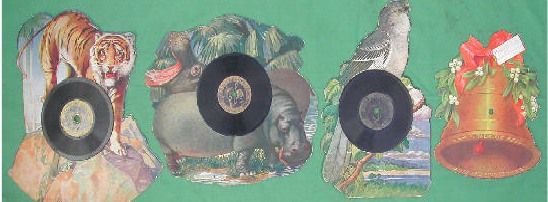
CHILDREN’S RECORDS
These were usually smaller than the standard 10 inch record and were made to be played on children’s gramophones.
Talking book Corporation. Possibly the most striking children's record was the Talking Book, produced by the Emerson Phonograph Company under license from the Talking Book Corporation. Introduced in May 1919, this venture was not destined for success. On January 26, 1921, creditors filed a petition in bankruptcy against the Talking Book Corporation. I have seen very few other examples. Further information can be found by visiting www.mainspringpress.com/kiddie.html
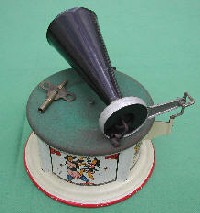
Three examples of the Louis Marx Children’s gramophone
A Louis Marx gramophone
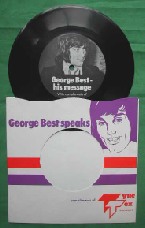
Examples of Ultra-Flexible records

|
|
 |
|



P3

P1
P3
P1