






 |
 |
 |
 |
CONTACT ME
HOME
ABOUT ME
ORGANS
BYGONES



GRAMOPHONES



Records
I have been collecting records since the mid 1960’s. Most of my records play at 78 RPM. As a child I spent most Saturdays going round the local jumble sales with my brother. The usual price for a record at that time was 1d. Yes ! an old penny. Most are still worth very little and turn up at auctions fairly regularly. Early records were single sided-
Many novelty records were issued over the years, and these are my main interest as they are good talking points, and some are very attractive.
Multi-
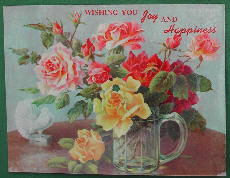
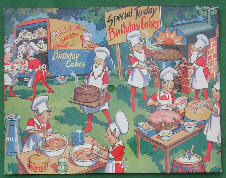
Card type records (shown above). These were very popular in the 1950’s with several firms supplying them. They are very attractive and are found in all speeds.
Tuck’s record cards are a much earlier attempt in this field. Production commenced in 1929 and is believed to be an attempt to sell obsolete cards as novelty items since most of the picture is obscured ! They were available is sets of four cards which included a protector and envelope. No attempt has ever been made to play my cards, confirmed by the centre hole which has never been perforated.
Try looking at www.lotz-verlag.de/Online-Disco-Tuck.html to find out more about these cards.
The card board durium records, as released in the US and Europe were light, unbreakable and not expensive to make. The producers were advertisement agencies and used these little brown card board cards for promotional purposes.
It is unknown how many of these tiny card board records were produced. Hundreds of these advertisements records that promote shoes, cars, chewing gum or magazines have been listed. You could learn new languages, tap dance or short hand if you liked. Some recording were made as souvenirs to remember your trip on an ocean liner or a summon to raise money. "Talkies" were small square records that were inserted in cigarettes packages and became collectibles, like the "Force" records you would find in Sunny Jim's famous multi wheat flakes food. Of course there were also series of children records, like the "Durium Mother Goose" of the "Durium For The Young Folks" records. The record was supplied in a sleeve listing other records in the series.
Of the later cards, the most common are:--
Melody Cards playing at 78 rpm. Record on front of an opening card.
Melody Cards playing at 45 rpm. Record on a large postcard.
Valentine’s Hi Fi Disc playing at 45 rpm. Disc pulls out of a slot in the card.
Fonoscope playing a 33 rpm. Record on a large postcard. Optional envelope supplied.
Vistasound “The Singing Picture” playing at 45 rpm. Record on a large postcard.
Tuck’s record cards are a much earlier attempt in this field. Production commenced in 1929 and is believed to be an attempt to sell obsolete cards as novelty items since most of the picture is obscured ! They were available is sets of four cards which included a protector and envelope. No attempt has ever been made to play my cards, confirmed by the centre hole which has never been perforated.
Try looking at www.lotz-
The card board durium records, as released in the US and Europe were light, unbreakable and not expensive to make. The producers were advertisement agencies and used these little brown card board cards for promotional purposes.
It is unknown how many of these tiny card board records were produced. Hundreds of these advertisements records that promote shoes, cars, chewing gum or magazines have been listed. You could learn new languages, tap dance or short hand if you liked. Some recording were made as souvenirs to remember your trip on an ocean liner or a summon to raise money. "Talkies" were small square records that were inserted in cigarettes packages and became collectibles, like the "Force" records you would find in Sunny Jim's famous multi wheat flakes food. Of course there were also series of children records, like the "Durium Mother Goose" of the "Durium For The Young Folks" records. The record was supplied in a sleeve listing other records in the series.
Of the later cards, the most common are:-
Melody Cards playing at 45 rpm. Record on a large postcard.
Valentine’s Hi Fi Disc playing at 45 rpm. Disc pulls out of a slot in the card.
Fonoscope playing a 33 rpm. Record on a large postcard. Optional envelope supplied.
Vistasound “The Singing Picture” playing at 45 rpm. Record on a large postcard.


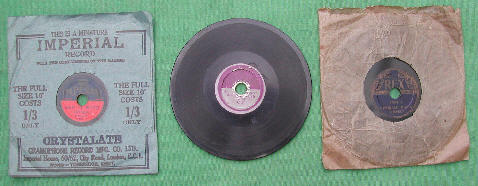
Miniature records (shown above). I have three of these 3½ inch records, two on Imperial, and one on Rex labels. The titles are as follows:-
Rex. Oh I Do Like To Be Beside The Seaside. Reginald Dixon.
Imperial (Red). Say It With Music. Jack Payne.
Imperial (Purple). Happy Days & Lonely Nights/Wedding March Band.
On the first two titles, the opposite side has a spoken message by the artist promoting the record label (who they recorded for at that time). These records are made from shellac, and play as any other record,
although you need to disconnect any auto-stop facility.
I have only ever seen these records on these labels, and very few at that. Reginald Dixon and Jack Payne were major stars of the day. I would welcome further information on these records.
Did any other labels issue similar records ?
I would be interested to know how you qualified for your complimentary record!
Rex. Oh I Do Like To Be Beside The Seaside. Reginald Dixon.
Imperial (Red). Say It With Music. Jack Payne.
Imperial (Purple). Happy Days & Lonely Nights/Wedding March Band.
On the first two titles, the opposite side has a spoken message by the artist promoting the record label (who they recorded for at that time). These records are made from shellac, and play as any other record,
although you need to disconnect any auto-
I have only ever seen these records on these labels, and very few at that. Reginald Dixon and Jack Payne were major stars of the day. I would welcome further information on these records.
Did any other labels issue similar records ?
I would be interested to know how you qualified for your complimentary record!

|
|
 |
|



P2
P2